AI-Generated Games: Famous Examples, Full Picture, and Building on SeaGames
🎮 AI-Generated Games: Famous Examples and SeaGames
In 2026, AI-generated games have moved from novelty clips to playable genre slices: procedural flyers, horror corridors, cozy quests, physics sandboxes, and 3D shooters now routinely appear as community-built demos on AI-first tools. Makers describe intent in plain language, preview often, and treat the thread as a living spec.
This guide walks through five famous AI-generated demos that people keep returning to, explains what modern AI-first workflows can deliver, and shows how SeaGames maps those ideas onto natural language → browser preview → chat revisions → publish when ready.
📌 What "AI-generated game" actually means
At minimum, people use the label when non-trivial parts of the build—logic, levels, meshes, sprites, audio, or game rules—are produced or heavily steered by models and tooling instead of only by hand-authored files in a traditional loop. That is not the same as "no human": the strongest work still has a human editor choosing verbs, cutting scope, and rejecting versions that merely compile.
Industry workflows often stack four lanes together: code or graph generation (rules, collisions, UI wiring), asset generation (2D/3D, materials, animation), audio generation (loops, stingers, VO reads), and game logic iteration (enemy waves, quests, economy knobs) through back-and-forth prompts.
SeaGames sits in the authoring + preview corner: the creative surface is language-first, the honesty check is "does it run in the tab the way I meant?", and the next message is a design decision, not a homework assignment on someone else's engine API.
🌍 Five famous prompt-led demos
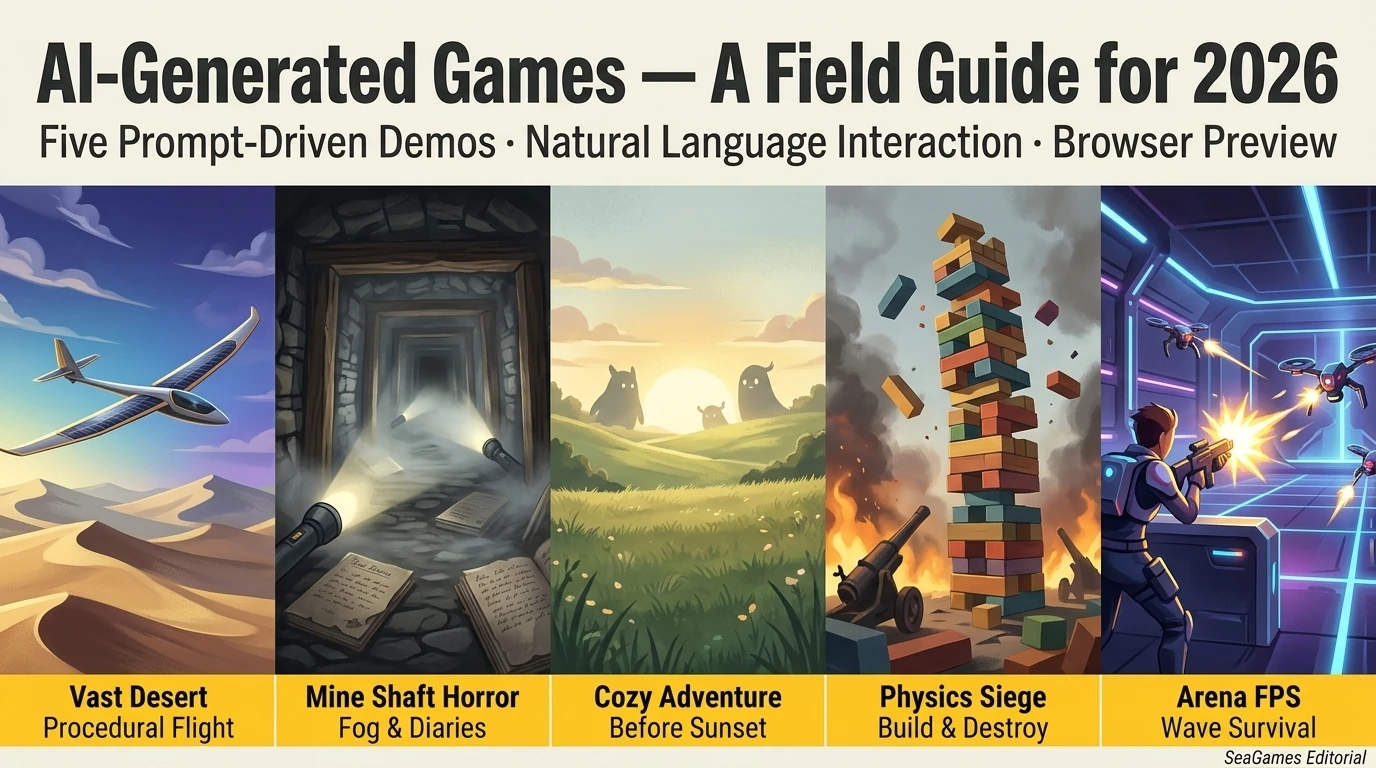
The examples below are widely cited community showcases on AI-first game tools. They are not a leaderboard; they are genre proofs—use them to calibrate ambition before you scope your own SeaGames project.
1. Desert Dunes Explorer — open-ended flight and procedural sand
This demo sells scale as mood: a glider over endless dunes, day-night gradients that rewrite the sky, collectibles that give the eye a reason to scan the horizon. Underneath is the harder engineering story—procedural terrain, time-based lighting, sand shaders.
Player fantasy in one line: "I want to feel small under a huge sky, but skilled at riding thermals of light."
SeaGames tip: Write a flight contract—max speed, turn radius, stall forgiveness, camera lag—before you ask for prettier dunes.
2. Cavernous Caution — horror as audio + fog + diary pace
Often credited to Rosebud community creator Boots.
Horror lives in restriction: tight sightlines, footstep echoes, text scraps that reframe what you think you heard. This mine setting leans on fog volumes, sparse light, and diary beats that land as you descend.
What the demo tests: whether the tool can hold negative space—moments where nothing jumps out yet everything feels wrong.
SeaGames tip: List three sound events and two light changes you want before you ask for a monster mesh.
3. Happy Llama: Magical Meadow — cozy pacing and quest glue
This demo sells whimsy under a deadline: a friendly llama helps animal friends before sunset, dialogue stays gentle, and particles carry emotion.
Why cozy is a stress test: cozy games fail softly—players quit from boredom, not rage. Your quest graph must offer micro-rewards every few minutes.
SeaGames tip: Name the emotional contract ("cozy," "uneasy," "triumphant") in the same breath as mechanics so the build does not default to graybox.
4. Castle Destroyer — building, then breaking, with intent
Here the hook is destruction literacy: you place blocks, assemble fortifications, then trade volleys with an opponent castle. The spectacle is physics—chunks, collapse lines, rubble piles.
Why physics demos go viral: they compress cause and effect into social clips—everyone understands a tower leaning wrong.
SeaGames tip: Specify material brittleness (wood vs stone), chunk size (comedy big pieces vs gritty dust), and camera distance.
5. The Last Free Man — 3D sci-fi shooter pressure
Public credit often names shawnBuilds on Rosebud AI.
This demo leans into a classic FPS fantasy: you are dropped into a dystopian arena, enemies arrive in waves, and the fantasy is systems that feel contemporary—weapon switching, opponents that pathfind instead of sliding on rails.
What "ambitious" means here: interaction density. Shooters punish tiny input drops and bad telegraphing faster than cozy walkers forgive them.
SeaGames tip: Borrow the acceptance tests—time-to-first-shot, time-to-first-hit-reaction, time-to-understand-why-you-died.
🏗️ How an AI-first stack fits together
Think of the stack as a negotiation ladder: at the bottom you lock the core loop (what one minute of honest play contains). In the middle you negotiate presentation (characters, world, mix). At the top you negotiate "prestige" asks—cutscenes, shader moods, networked modes—only after the ladder still stands when you shake it.
Layer A — Natural language game design
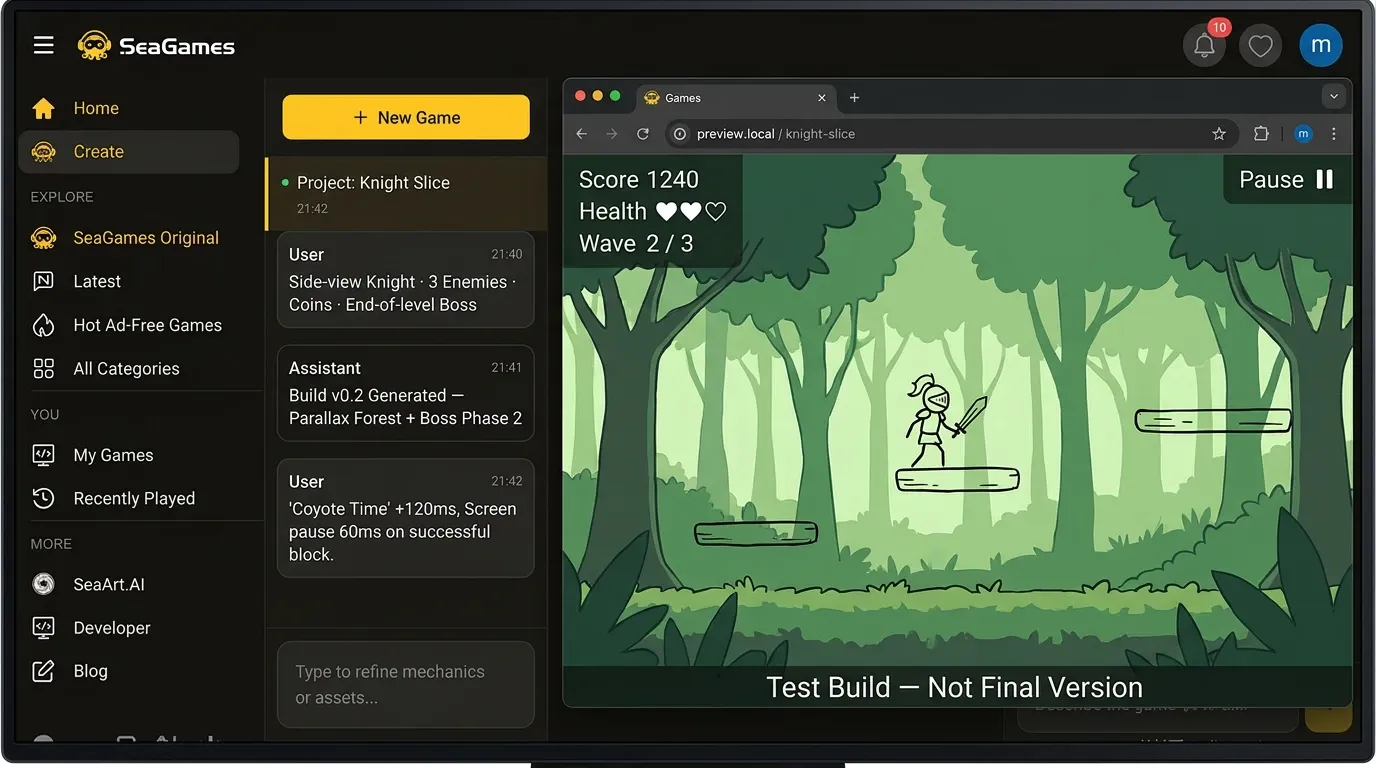
You describe verbs, cameras, fail states, and progression. The system proposes structure—scenes, entities, UI stubs—then you answer with revisions in the same channel: "first wave reads unfair," "give me a two-phase boss," "jump needs coyote time."
Acceptance criteria beat vibes. Replace "make it cooler" with observable checks: "player always knows why they died," "tutorial completes in under 90 seconds."
Layer B — Assets & motion
2D characters usually need idle + move + hit before they feel real; 3D props need scale references; materials need adjectives ("dusty," "wet," "hand-painted low-poly").
Style anchors reduce thrash. Pick 3–5 reference adjectives and 2 forbidden looks ("no neon," "no photoreal gore") before generating variants.
Layer C — Audio direction
Loops, one-shots, VO reads, and "space" itself (mine echo vs meadow air) steer emotion faster than extra meshes. Treat audio prompts as part of the spec, not polish at the end.
Accessibility: subtitles for VO, separate volume sliders where supported, and color choices that still read for common types of color vision deficiency.
⚠️ What still resists one prompt
Know the wall early, and pair it with a mitigation you can ship this month.
- MMO-scale persistence — sharding, economy exploits, chat moderation. Mitigation: Lobby hub + cosmetic persistence first.
- Specialized simulation — medical, tire/slip sim fidelity. Mitigation: Trusted abstract meters over raw physics.
- Novel-length branching — casting, localization, continuity QA explode combinatorially. Mitigation: Episodic acts; canon wiki.
🚀 Getting started on SeaGames
Five beats to ship your first AI-generated game:
- Write a vision a stranger can test in one sitting—one-paragraph spec + three acceptance tests.
- Generate → play → note friction—one axis per follow-up prompt.
- Focus on fun, clarity, identity—not syntax flexing.
- Steal structure from famous demos (loops, audio, fail clarity), not screenshots.
- Snapshot prompts when a build feels right—save named versions.
Strong seed examples:
- "Robot factory escape — 3 hazards, 1 boss, zero cutscenes."
- "Hospital horror — flashlight battery is the core resource."
- "Orb puzzle — connect colors, ≤4 rules on screen."
What SeaGames optimizes for: Authorship in everyday language—you keep design authority (pacing, fairness, clarity), the platform helps assemble runnable drafts you can preview in the browser, and your backlog stays in sentences until you deliberately go deeper.
✅ Closing
Famous AI-generated games are proof of range: shooters, sandboxes, coziness, dread, endless vistas—all started as sentences someone dared to stand behind in public. They are not a promise that every prompt becomes a franchise; they are evidence that authorship is widening.
On SeaGames, keep the editor's chair: conversation first, preview often, publish when the build earns its name, and treat AI as the fast clerk that drafts—while you remain the director who cuts.
The question is not whether these tools exist; it is what honest game you will put in front of players next week.