

AI Game Logic Development: From Intent to Playable Code
🎮 AI Game Logic Development: From Intent to Playable Code
When you tell an AI "I want to make a game where zombies chase players," how much does it really understand? The answer in 2026 is: it depends on how you structure that request.
This guide teaches you how to transform vague game ideas into precise, playable logic systems—without learning any engine APIs. All you need is natural language and collaborative AI interaction.
📌 Why This Matters
When you say "make a zombie chase the player," the AI faces ambiguity. It doesn't know: how far away can the zombie "see" the player? What happens when the zombie loses sight of the player? What penalty does the player face when caught? Does the zombie need wind-up time before attacking?
In traditional game development, programmers define these rules through code. But in the AI era, you can use natural language to describe these questions and let AI build the logic for you.
🧠 The Five-Step Framework: Intent to Logic
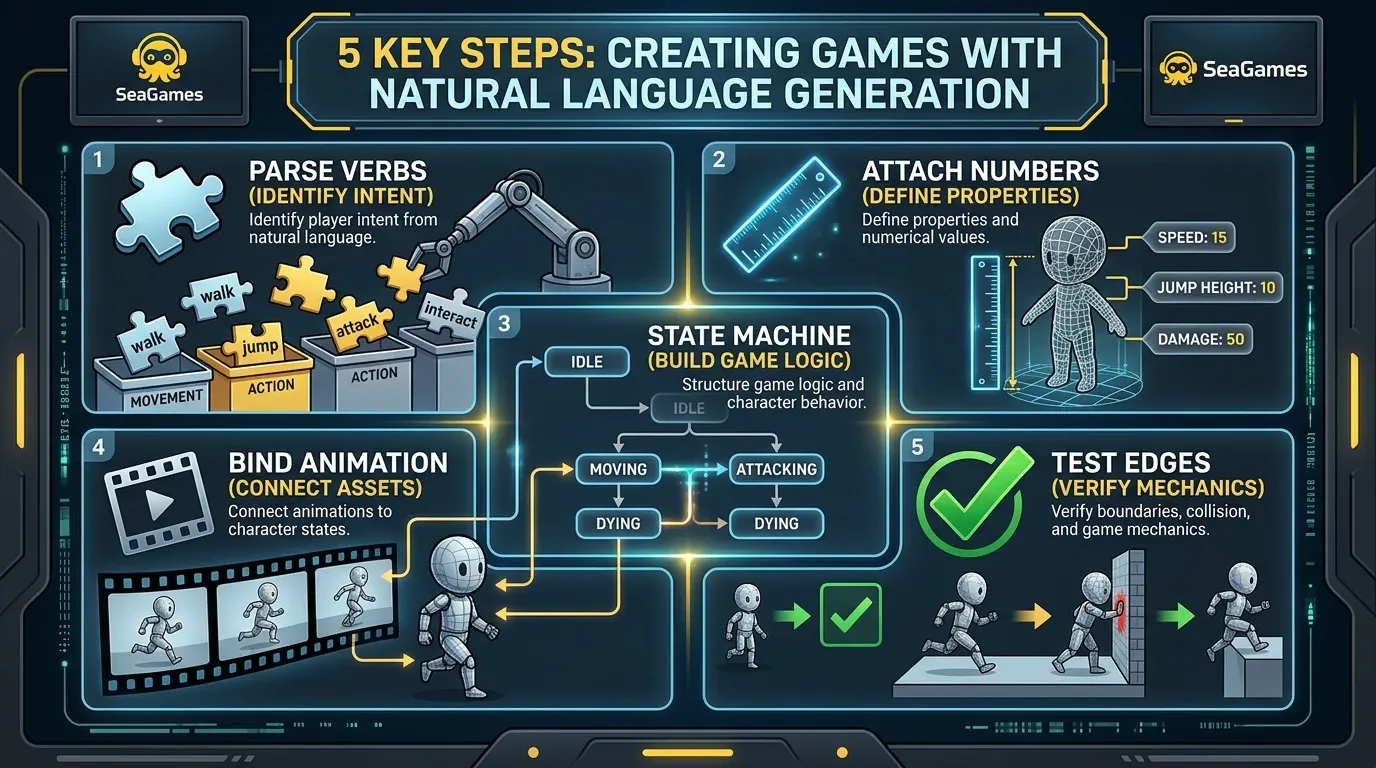
Step 1: Parse the Verbs
Break down the player's description into specific action verbs. For "zombie chases player," these are: Wander, Detect, Chase, Attack, and Recover.
Step 2: Attach Measurements
Each behavior needs specific numerical parameters: Detection Range (e.g., 8 meters), Attack Range (e.g., 1.5 meters), Chase Speed (e.g., 3 m/s), Lose Interest Threshold (e.g., 15 meters), and Attack Cooldown (e.g., 2 seconds).
Step 3: Define the State Machine
Define the transition rules between states. For example: When in "Wander" AND distance less than detection range, switch to "Chase." Also set guard conditions: e.g., "cannot attack while stunned."
Step 4: Bind Animation Intent
Each state should have corresponding visual feedback so players can predict enemy behavior. Key principle: Players should read enemy intent from animations. This is the foundation of fairness.
Step 5: Test Edge Cases
Test boundary scenarios: Where does the zombie go when the player hides? Do two zombies collide? What happens when the zombie gets stuck?
🧟 Complete Example: Zombie AI Logic
Here's a production-ready prompt you can copy directly into SeaGames:
Create a zombie enemy AI with the following behavior logic:

【State Machine】
- Wander: Move randomly at 1.5 m/s, change direction every 3 seconds
- Detect: Detection range 8 meters, switch to Chase when player enters range
- Chase: Pursue player at 3 m/s, enter Search state when player breaks line of sight
- Search: Stay at player's last known position for 5 seconds, return to Wander if not found
- Attack: Trigger when distance < 1.2 meters, deal 30 damage, 2 second cooldown
- Recover: 0.5 second stagger animation after attack

【Guard Conditions】
- Cannot enter Attack state when stunned
- Movement speed reduced by 50% when health < 20%
- All behavior stops immediately on death

【Animation Requirements】
- Wander: Slow walk, slight body sway
- Detect: Brief head turn toward player (~0.3 seconds)
- Chase: Running, body leaning 15 degrees forward
- Attack Wind-up: Arms raise, 0.4s charge (play warning sound during this time)
- Hit Response: Brief white flash + 0.2s stagger
📝 Ready-to-Use Prompt Templates
Copy these production-ready templates into SeaGames:
🛡️ Boss Battle Template
Create a boss enemy with these characteristics:
- 500 HP
- Phase 1 (100%-50% HP): Two attack patterns (melee swing, ranged fireball)
- Phase 2 (<50% HP): Enrage state, attack speed +30%, add third attack (dash)
- Every 25% HP lost: Enter brief vulnerable state (3 seconds, cannot move)
- Clear visual and audio warning before each attack (minimum 0.5 seconds)
- Player can interrupt boss special skills
🏃 Multi-Unit Pursuit Template
Create a group of enemy AI (3-5 units) with coordinated behavior:
- Rusher: Fastest (4 m/s), charges directly at player
- Suppressor: Maintains distance (10m), provides ranged coverage
- Scout: Does not attack directly, monitors and reports player position
- Rules: Rushers never enter 3m range of player; Suppressors only attack when Rusher is alive
- When any unit detects player, all units receive notification within 1 second
🎯 FPS Enemy Template
Create an FPS enemy AI with the following behavior:
- Behavior loop: Patrol → Detect Player → Find Cover → Fire → Reposition
- Cover logic: Prefer positions not directly visible to player, within 15 meters
- Firing rules: Fire after 1 second of exposure, 0.5s burst, 0.8s interval
- Cover switch: Change cover if in same position >5 seconds OR player approaches within 5 meters
- Flee condition: 30% chance to attempt escape when HP < 30%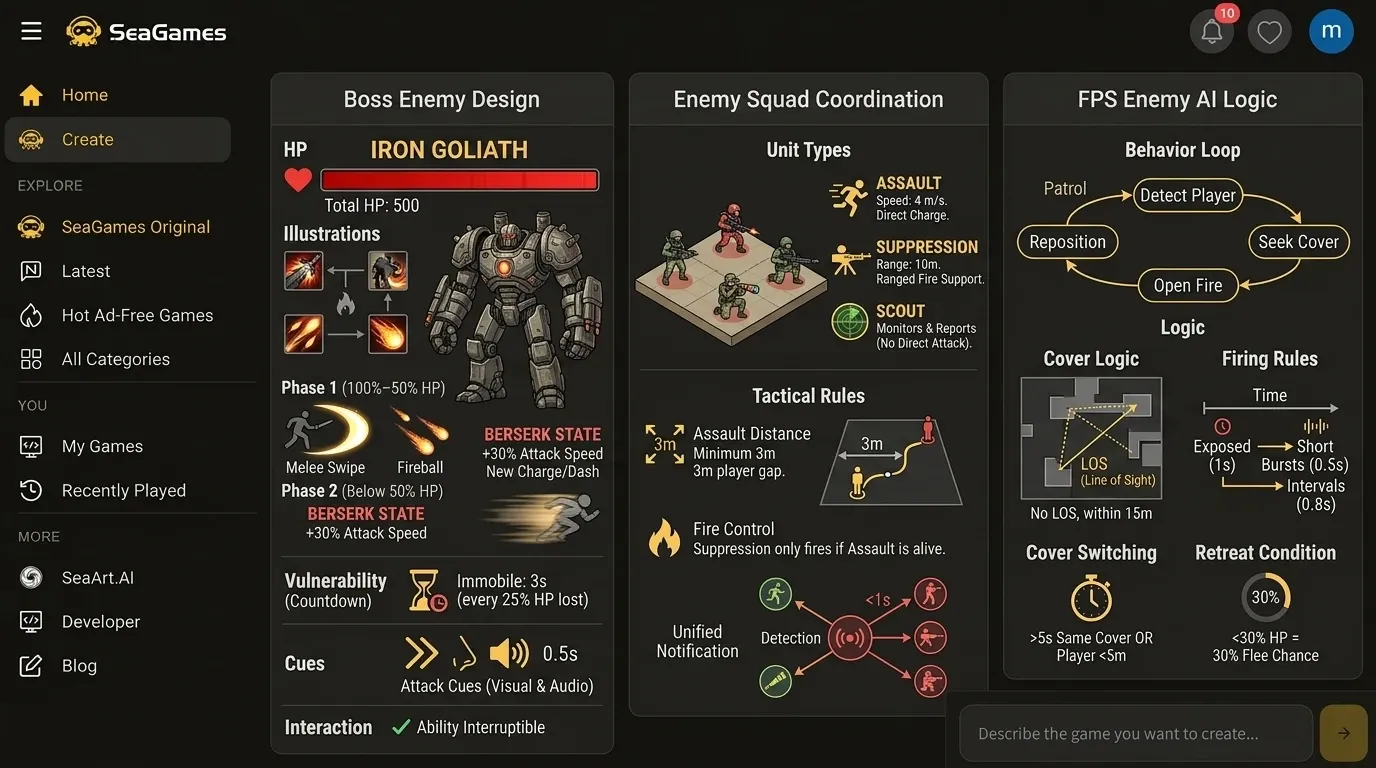
✅ Common Game Patterns You Can Implement
| Pattern | Description | Use Case |
|---|---|---|
| Patrol → Detect → Chase | Basic enemy loop with alert state | Stealth games, tutorials |
| Phase Boss | Behavior changes at HP thresholds | Boss battles, dramatic fights |
| Squad Tactics | Multiple units with role separation | Tactical combat, FPS |
| Cover System | Find and use environmental cover | Shooters, tactical games |
| Aggro Management | Target switching based on threat/distance | MMO, RPG combat |
⚠️ Common Pitfalls & Solutions
Pitfall 1: State Explosion
Problem: Too many states defined, causing unpredictable AI behavior. Solution: Start with no more than 5 states. Use MVP thinking—get a running version first, then add states gradually.
Pitfall 2: Unbalanced Numbers
Problem: Unreasonable values leading to broken gameplay (e.g., enemy runs faster than player). Solution: Start with player speed as baseline (1.0), set enemy speed to 0.7-0.9 for easy, 1.0-1.1 for hard.
Pitfall 3: Fairness Issues
Problem: Enemy attacks without any warning. Solution: Every attack must have wind-up animation + audio cue, with wind-up time at least 0.3 seconds.
Pitfall 4: Context Loss
Problem: After long conversations, AI forgets early-set values. Solution: Paste a spec summary at the beginning of your prompt to ensure AI remembers core parameters.
📖 Glossary
| Term | Definition |
|---|---|
| State Machine | A system of discrete modes with defined transitions |
| FSM | Finite State Machine with limited states |
| Behavior Tree | Hierarchical model for AI decision-making |
| Wind-up | Warning animation before attack connects |
| LOS | Line of Sight - whether entities can see each other |
| Aggro | Which target the AI focuses on |
❓ Frequently Asked Questions
| Question | Answer |
|---|---|
| Do I need programming knowledge? | No. This guide teaches you to describe logic in natural language. The AI handles code generation. |
| How many states should I start with? | Start with 3-5 states. More states = more complexity = harder to debug. |
| How do I balance enemy difficulty? | Set player speed as baseline (1.0). Enemy speed 0.7-0.9 for easy, 1.0-1.1 for hard. |
| Can I create friendly NPCs? | Yes! Replace "Attack" with "Interact" or "Heal." Friendly NPCs need states like Greet, Follow, Idle. |
| What if the AI generates buggy logic? | Use Debug mode to visualize state transitions. Test each state individually before testing transitions. |
| How do I handle multiple enemies? | Use object pooling. Specify "Limit active AI entities to 10" in your prompt. |
| Can SeaGames help? | Yes. SeaGames provides natural language → browser preview. You see logic run instantly and iterate through conversation. |
| What's the most common mistake? | Setting numbers without testing. Always start with conservative numbers and increase through iteration. |
| How to make AI feel smart but fair? | Add deliberate weaknesses: "Enemy has 2-second decision delay in cover." Smart doesn't mean perfect. |
| What's the difference between Wander and Patrol? | Wander is random movement. Patrol follows a predefined path between waypoints. |
✅ Summary: Predictable Surprise
Predictable means players can read enemy intent from animations—this is the core of fairness. Surprise comes from strategic depth—when to attack, when to hide, when to pursue.
The key is translating vague "feelings" into specific "rules." When you master this, AI becomes your most efficient creative partner.
Ready to start? Head to SeaGames, paste one of our templates, and watch your logic come to life in the browser preview.