

بناء لعبة FlappyBird على SeaGames باستخدام اللغة الطبيعية—محاضرة بدون تعليمات برمجية
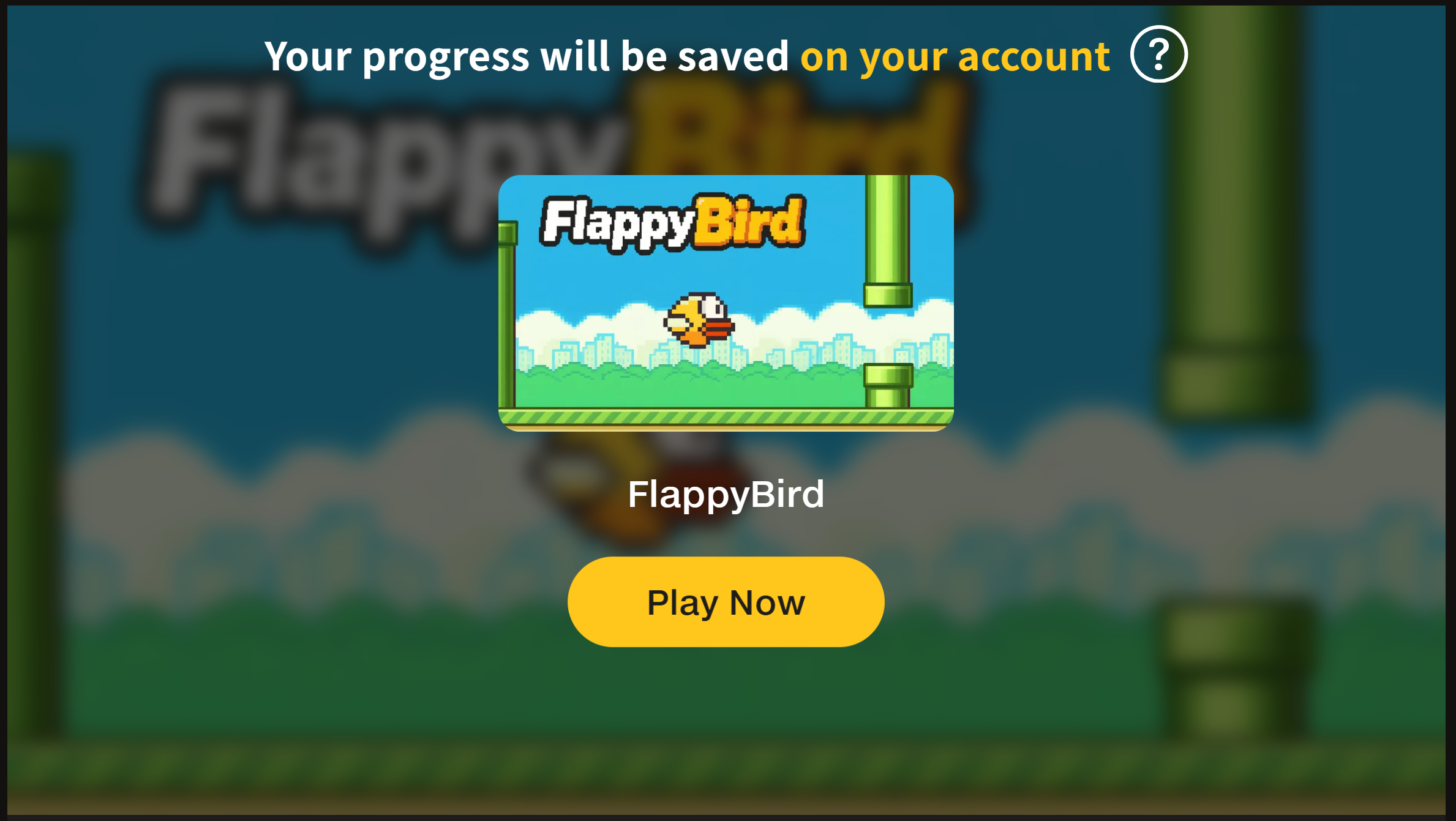
🐤 Make FlappyBird on SeaGames: Natural Language, Your Build
Many “how we built Flappy Bird with AI” write-ups read like a mini textbook: gravity constants, hitbox sizes, object pools, frame budgets. That is useful for engineers—yet it is the opposite of what most SeaGames creators need first when they want to author a game. SeaGames is built around natural language: you describe what your build should do, you preview what you made in the browser, you revise the feel in the next sentence—not after three nights of reading docs.
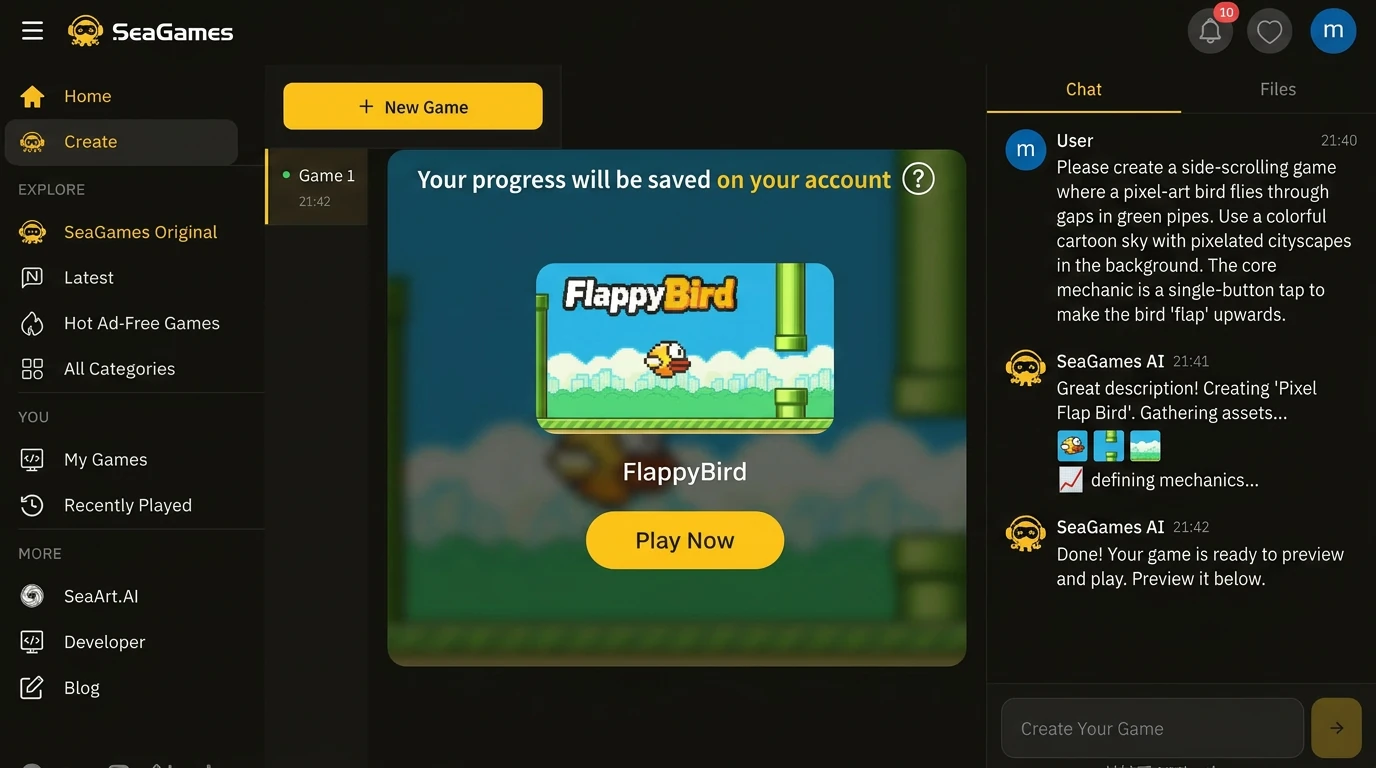
This piece is about making a small flyer game on SeaGames and shipping it as FlappyBird—tap to rise, dodge gaps, restart fast—not about browsing the catalog for someone else’s file. The point is the shortest create loop: “describe → generate → preview your build → tweak in chat” so you learn real design judgment while you are producing, not while you are shopping.
What SeaGames optimizes for. Turning plain sentences into a working draft you own, previewing it in the tab, then tightening one axis at a time. You still care about fairness and feedback—you are just not stuck behind boilerplate before your first self-made playable.
📌 What FlappyBird is (in one breath)
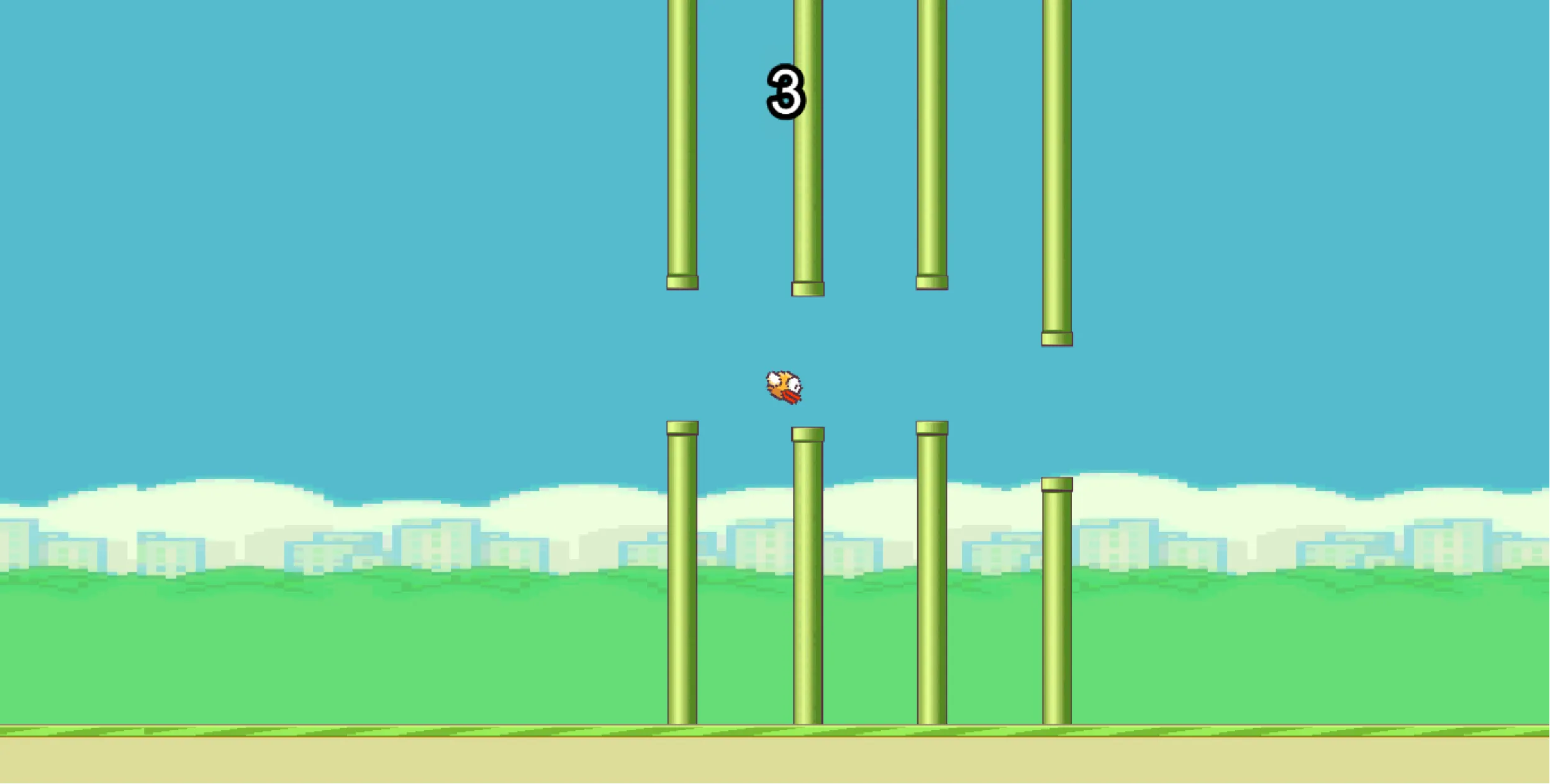
When you make FlappyBird, you commit to a tiny spec: one character stays on screen; gravity pulls it down; each tap adds lift; obstacles scroll in; touching them or the ground ends the run; score ticks when you clear a gap; restart is one obvious action. That is the whole surface you are implementing—small enough that you can reason about it while the first version is already being assembled from your words.
💬 What you type instead of memorizing code
You do not need to recite “pixels per second squared” to get a first pass. Plain intents already carry the lesson: heavier fall, snappier flap, wider gap for the first minute, show score top-right, freeze input on game over, restart on space. Each phrase maps to player experience; the system bridges toward implementation while you stay in design vocabulary.
When something feels wrong in your build, stay in the same channel: “first pipe comes too soon,” “tap sometimes ignored on mobile,” “bird should tilt slightly with speed.” That is how SeaGames stays authoring-first—you are not auditioning for a compiler exam before you earn a version you created.
🔁 A tiny workflow that scales later
1. State the core loop you want to build in one short paragraph (tap, obstacles, lose condition, restart).
2. Generate a first draft, then preview your own build in the browser—note only feel problems, not implementation guesses.
3. Change one axis per message: difficulty, speed, gap size, input forgiveness, or UI clarity—still in natural language.
4. When it is ready, publish or share your FlappyBird; watch where testers die or hesitate—that backlog stays in human language until you choose to go deeper.
If you later export to a traditional engine or hire a coder, you will already have a felt spec—the expensive part many projects skip because they started in syntax instead of verbs.
🧠 What you are really learning
Making FlappyBird still trains timing, readability, and failure clarity—the same muscles bigger genres need. SeaGames lets you rehearse those muscles while scaffolding is assembled from your prompts, so your attention stays on “does my build respect the player’s thumb and patience?”
✅ Closing
You do not need a lecture on collision math to deserve a working FlappyBird you authored on SeaGames. Start with honest language about how your build should feel, preview and revise while it runs in the tab, and let low-level complexity arrive only when your design questions actually need it. The platform’s bet is simpler: conversation first, a build you own quickly, polish forever.
Make the tiny bird—argue with the gap width in sentences your collaborators understand—then ship it. That is already game design; SeaGames just keeps the door wide enough that you walk through it as a creator today.